
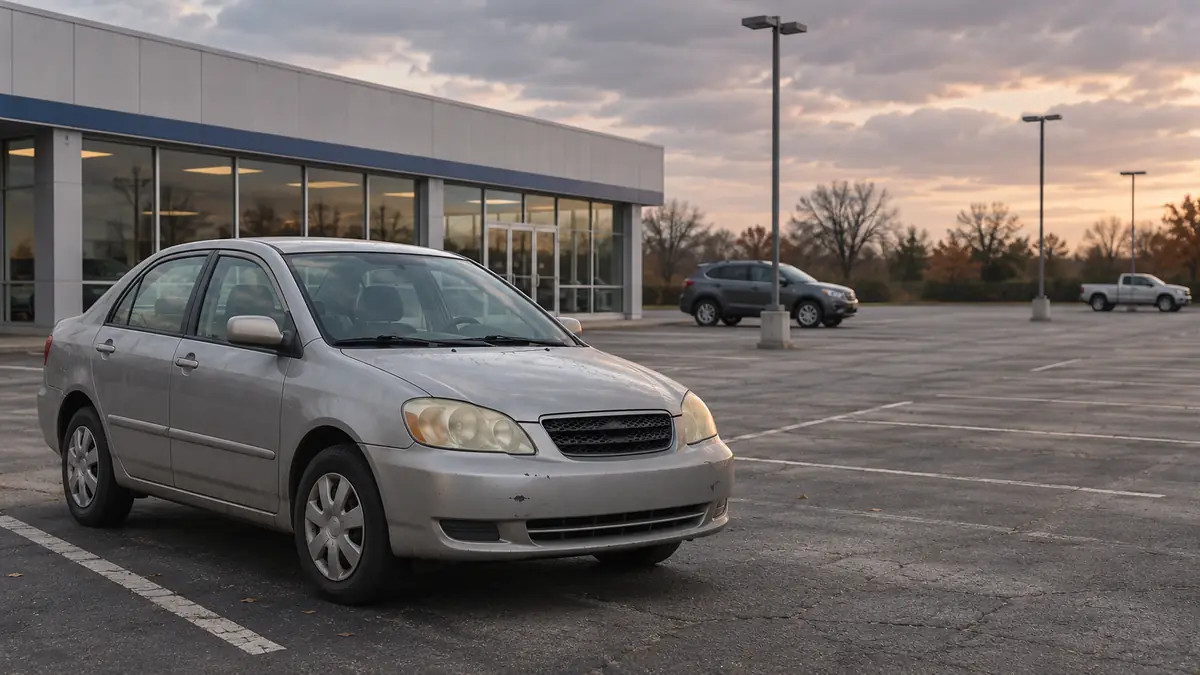
A fuller lot doesn't mean more affordable cars
When a new-car payment becomes unworkable, the usual advice is to buy used. The trouble is that the next rung on the affordability ladder may be missing.
In October 2026, U.S. franchised and independent dealers listed approximately 2.19 million used vehicles, roughly unchanged from a year earlier. Yet inventory priced below $15,000 had fallen 19.3% year over year. The segment accounted for 15.8% of dealer-listed supply, down from 19.6%, with only 34 days' supply against 49.2 days across the market. [1]
That distinction matters: an inventory recovery is not necessarily an affordability recovery.
The gap persisted across three reporting periods:
| Inventory month | Under-$15,000 share in 2025 | Under-$15,000 share in 2026 | 2026 days' supply |
|---|---|---|---|
| August | 20.6% | 15.1% | 29 |
| September | 19.4% | 15.7% | 34 |
| October | 19.6% | 15.8% | 34 |
Source: Cox Automotive/vAuto reports published September 11, October 16 and November 13, 2026. These figures measure dealer-listed inventory, not private-party listings. Days' supply reflects inventory relative to the estimated sales pace—not the time any one car will take to sell. [1][2][3]
What happened to the car under $10,000?
The shortage is particularly visible at the bottom of the market. Manheim reported that vehicles listed under $10,000 had just 33 days' supply in May 2026, the tightest price band in the cited vAuto analysis. At the same time, Manheim said approximately 150,000 vehicles per month in that price range passed through its wholesale marketplace, based on 2025 transactions. [4]
Those findings are not contradictory. Wholesale availability does not guarantee safe, economical, retail-ready transportation. A dealer still has to buy, inspect, repair, transport, merchandise and stand behind the vehicle at a price customers can afford.
The evidence therefore points to a constrained dealer-retail market, not the literal disappearance of every inexpensive car.
The supply problem begins years before a used-car listing appears
Other pressures are better documented. Pandemic-era production disruptions reduced the number of vehicles entering the fleet. Fewer new-vehicle leases also mean fewer relatively recent vehicles returning for resale. Reuters reported that leasing accounted for about 30% of new-vehicle deals before the pandemic, compared with 23% in the first half of 2026. [14]
Off-lease vehicles do not immediately become sub-$10,000 cars. The connection is a long-term pipeline: fewer vehicles entering circulation in earlier years can limit the mix available to later owners and dealers. Meanwhile, buyers who cannot afford to replace their current cars may keep them longer, slowing the flow of trade-ins. These mechanisms can operate alongside repair and salvage decisions rather than compete with them as a single explanation.
Are cash-for-cars businesses part of the explanation?
Another possible pressure point sits between the repair shop and the salvage auction: are instant-cash buyers acquiring vehicles that might otherwise have remained affordable transportation?
The channel certainly exists. In its fiscal 2026 annual report, Copart describes its CashForCars operation as purchasing vehicles directly from the public and reselling them for its own account. Peddle, another instant-offer service, explains that vehicles collected by its buyers may be resold, dismantled for parts or scrapped, depending on their condition and the buyer. [10][11]
That creates a plausible path out of local affordable retail. Faced with an expensive repair, an owner might accept a convenient cash offer rather than repair the vehicle or sell it privately. A buyer might then discover that the parts, salvage or export value is more attractive than the cost and risk of preparing the car for a nearby retail customer.
But a plausible mechanism is not proof of a nationwide cause. Neither company's disclosures establish how many otherwise roadworthy, sub-$10,000 vehicles have been diverted from ordinary retail. And a vehicle sold through an auction is not necessarily destroyed: Copart's buyers include rebuilders, used-car dealers, dismantlers, exporters and consumers. [10]
The broader repair-versus-retirement economics are measurable. CCC Intelligent Solutions reported that 23.1% of claims in its 2025 insurance-claims dataset were flagged as total losses, a high in its series. It identified older vehicles, rising repair costs and changing claim behavior as contributing factors. That is a share of insurance claims, not a share of all vehicles on the road or a measure of cash-for-cars purchases. [12]
There is also an important counterweight. S&P Global Mobility reported a relatively stable 4.5% scrappage rate and a record 12.8-year average vehicle age in 2025. Americans were keeping vehicles in service longer, not collectively scrapping them at an unprecedented rate. [13]
The hypothesis is worth investigating, especially in individual local markets. For now, the defensible conclusion is narrower: cash buyers and salvage channels can redirect older vehicles away from conventional retail, but available evidence does not show that they are the leading cause of the affordable-car shortage.
The sticker price is only the beginning
The average used-vehicle listing price reached $27,133 in October 2026, up 4.9% year over year, according to Cox. That is an asking-price measure, not the average transaction price. [1]
Financing adds another hurdle. Experian's second-quarter 2026 data put the average used-auto-loan APR at 11.19%, with an average loan term of approximately 68 months. The rate was lower than the 12.12% recorded in Q2 2024, but it remained substantial for buyers focused on monthly affordability. These averages cover used-car loans broadly; they are not a financing quote for a $10,000 vehicle. [5]
Negative equity can make switching cars harder still. Edmunds found that 29.1% of trade-ins with outstanding loans toward new-vehicle purchases were underwater in Q3 2026, with average negative equity of $7,107 among those trades. The measure does not cover every trade-in or used-car transaction. Nevertheless, the mechanism is clear: an owner must either pay that deficit or carry additional debt into the replacement purchase. [6]
An affordable car is not simply one with a low advertised price. The true test includes the amount financed, interest, ownership costs, likely repairs and the buyer's existing equity position.
What dealers are seeing—and what the numbers can't tell us
A September 2026 DealerRefresh discussion offered a useful ground-level view. One contributor reported an analysis of 10,823 priced used-car listings posted to Facebook Marketplace across 196 dealerships, with a $28,295 median asking price and only 714 vehicles (6.6%) priced below $10,000. The contributor disclosed a commercial interest in the underlying software. These Marketplace listings do not necessarily represent each dealership's complete inventory; the sample also excludes private-party listings and is not a nationally representative survey. [7]
Its practical value lies in the question it raises: how many of a dealer's vehicles actually fit the budgets of local buyers? A high overall inventory count cannot answer that question.
The related operational challenge is reconditioning. Every acquisition needs an allowance for inspection, safety work, tires, brakes, transport, preparation, holding time and post-sale risk. NIADA's March 2026 practitioner interviews illustrate why recon decisions differ among dealerships; they do not establish a national cost benchmark. [8]
One potential sourcing channel is the service lane. Cox's ownership research found that 14% of surveyed consumers had been offered a trade-in valuation during a service visit, while 33% expressed strong interest. That suggests an opportunity to speak with owners before vehicles reach other buyers, not a guarantee of cheap or retail-ready inventory. [9]
What to Watch Next
For buyers, the relevant comparison is total ownership cost—not simply the advertised price or monthly payment. Financing terms, maintenance prospects, insurance, inspection history and existing negative equity all matter.
For dealers, the opportunity is to measure the affordable-vehicle pipeline more precisely. Track acquisitions and sales by price bucket, all-in reconditioning cost, time to frontline, and realized margin. Study which vehicles are lost to wholesale or salvage because repair costs make conventional retail uneconomic.
For industry researchers, the unanswered question is unusually specific: what share of older, mechanically repairable vehicles sold to instant-cash buyers are dismantled, exported, wholesaled or returned to domestic retail? Answers by vehicle age, condition and region would help distinguish a real supply diversion from normal end-of-life recycling.
AutoIntel will watch low-price dealer inventory, financing terms, trade equity, repair-versus-total-loss decisions and the fate of aging vehicles through 2027.
The affordable used car has not literally vanished. But the path from an aging vehicle to safe, affordable transportation has narrowed—and some of those paths lead somewhere other than the local used-car lot.